by Jun Homma and Kōichi Shimizu
Quite some time ago, I bought two pieces of fabric offcuts from a kimono shop. These were the remainders from obi sashes.
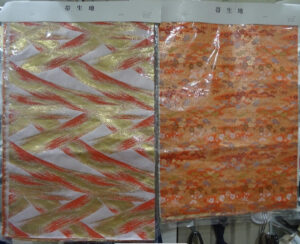
Attracted by the vivid colours and patterns, I bought this material with no clear idea of what I would make with it. I hung it on the side of the bookshelf in my study.
The pieces are artificial silk, but designed to seem like the real silk Nishijin-ori brocade found in luxury kimonos or obi sashes. The gold and silver threads are woven to create abstract patterns. Other ways to weave silk include Chirimen crepe with a very fine, uneven surface that is pleasant to the touch, and Tsumugi pongee whose strong fabric is made from waste silk cocoons. Tsuzure-ori meanwhile has a thick silk weave with artistic picturesque patterns seen on wall hangings and the long drop curtains in theatres.
Offcuts of these silk and artificial silk weaves provide excellent material for handicraft enthusiasts: pouches, handbags, cushion covers, corsages, hair ornaments, kimonos for dolls and small stuffed animals with unique ethnic fabric patterns. Some people sew patchwork tablecloths, luncheon mats and tapestries, others, small stuffed objects and hangings from threads. These mobiles mark New Year celebrations and the annual Girls’ Festival on 3rd March. Also popular is the remaking of older kimonos into western style outfits.
The kimono tailoring shop where I found my fabric has been closed for many years. Kimonos worn as everyday dress had already fallen out of fashion, and the only items being made to measure at independent tailors were formal wear and women’s visiting kimonos. As the number of women wanting to wear kimonos declined, tailors gradually decreased. My mother owned several bespoke kimonos for going out, but I don’t have any single one. These days, kimono hire services are extremely popular for formal occasions like weddings.
My father, who was born in 1926, talks of his younger days in the countryside near Tokyo. As there were no school uniforms in public primary schools, children of the village wore their everyday wear, cotton kimonos and clogs, to school. He was the only one among his classmates with Western clothes and shiny shoes. His parents went to a department store in Tokyo to buy the latest fashionable clothes of the city children for their son. He recalls the embarrassment of standing out in this way.
His family ran a filature, a place where silk is extracted from silkworm cocoons. These cocoons were bought from farmers round about and the silk yarn was sent to the port of Yokohama for overseas markets.
After the Great Depression, international sales of Japanese silk yarns suddenly dropped. The local filatures went bankrupt and eventually disappeared along with the mulberry fields. A few Japanese silk mills were able to survive by installing advanced automatic reeling machines instead of employing female labourers.
According to my father, the profits of his family’s factory were spent haphazardly on household expenses, and no funds were set aside for depreciation. It is now widely recognised as important for companies to budget and to reconcile accurate income and expenditure by matching revenue and expenses through depreciation. Instead, my father’s family-run factory couldn’t grasp its true profits because of the lack of a system. During the economic boom there were high apparent profits, which were freely spent; when the recession struck, there were few available funds to repay loans or make capital investments. He explains that this immature management was the reason why the business went bankrupt.
The family fell into such financial difficulty that my father was on the verge of leaving education all together, until his grandfather somehow secured the tuition fees. Secondary grade education near home was focused on specialist agriculture and not his hoped-for preparation for university.
Following secondary school graduation he went to the Higher School of Agriculture and Forestry. Excellent grades caused him to be selected as a special student, reducing the burden of tuition fees during secondary and higher studies. However, the family’s financial difficulties persisted, and the prospects of going to university were not bright. As events of the Second World War went against Japan, his education was often interrupted by daily labour mobilisation. Students including himself were eventually mobilised as trainee soldiers. This was less than three months before the war would end.
When the war ended, the school decided to bring forward graduation by six months. However, it was even more difficult for him to go on to university. He had to earn money to support his parents and six younger siblings amid the after-war economic slump. Consequently, he gave up taking a transfer admission exam to university.
In the chaotic post-war period he took the Senior Civil Service exam alongside university graduates, passed, and was recruited by the National Personnel Authority, where his duties afforded him the opportunity to study the job classification based on the civil service grading system. On retirement, he set up a business based on his study.
He is proud of this achievement, but there remains a nagging regret that, as the heir of the proprietor, he was not able to re-establish the family’s silk business. Times had moved on, however, and the days of Japan’s silk industry were over. It seems to me that my father had chosen a business career that suited him relatively well, which he had achieved through his own efforts.
Eighty years have passed since the end of the war. The Japanese lifestyle has rapidly westernised, or rather, Americanised. Much has changed compared to when my father was a child.
In my lifetime I have not seen a pupil wearing a kimono to school. When I was a teenager, young people were indifferent to traditional clothing and didn’t consider it particularly valuable. Seen as old-fashioned, it was only when Japan gained economic confidence that the cultural value of the kimono was reassessed. By then, silk kimonos had become a luxury item worn on only very special occasions.
The Coming of Age Day ceremony in Japan is an opportunity to dress in traditional attire. Groups of young ladies wearing furisodes gather at celebrations organised by each local authority. Most young women do not want to miss this rare opportunity, although far fewer men show any interest in wearing haori and hakama, their formal attire. At the venue, apart from that handful of young men, suits are now the norm.
Some of the young women buy new furisodes and obi sashes for the day, others inherit these garments from their mothers. Still others, like my daughter, buy them from second-hand kimono shops. The majority opt for rental. Rental kimonos and obi are reasonably priced, and the time and worry of cleaning after use is reduced, so these shops thrive today. While artificial silk kimonos and obi are reasonably priced, real silk kimonos are in high demand for the quality of their print, colours, design, texture and lustre. For a wrapped furisode not to come loose during wear, a stiff obi is tightly wound round the body and tied in a three-dimensional form. This is a specialist skill. Beauty salons offering kimono dressing services with hair setting are fully booked on ceremonial days.
After repeated wear, rental kimonos and obis end up on the reused clothes market or are re-made as offcuts sold in fabric shops and online. I like to window shop online for kimono offcuts and imagine what could be made from the material.
As I look at the two pieces of kimono offcuts in my study, I wonder about sewing some Barbie evening dresses. But I hesitate, because I also feel it would be a shame to apply scissors to these beautiful weaves. And, I wonder if my sewing skills will be up to it.
––––––––––
NOTES by the writer:
I wrote this exObject story with my father, who is 100 years old.
The top photograph shows two pieces of 70 cm x 50 cm offcuts in my study. Each package is printed with the words “Obi fabric. 100% rayon with gold and silver thread”. The fabric on the right has a flowing water pattern of swirling curves scattered with three types of woven plants, pine branches, bamboo leaves and plum blossoms. Streaming water is an auspicious pattern signifying the removing of dirt, while the three types of plants, evergreens and early spring blooms symbolise strength to endure the cold of harsh winter. The fabric on the left is not a traditional design and is probably based on the artist’s contemporary taste.
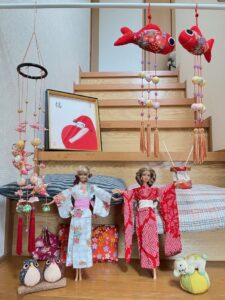
The bottom photograph shows some traditional handicrafts I made from offcuts in my house. The doll kimonos and the artificial Chilimen cushion covers are my mother’s work. She enjoyed sewing in between her busy civil servant duties, often making dresses for herself and me. I admit to rarely putting the sewing skills I learned at school to use as she did. The padded cloth picture in the frame was made by my mother-in-law. The mobiles are my father’s souvenirs from Shizuoka for his granddaughter.
––––––––––
A ‘furisode’ is a formal kimono for young unmarried women, characterized by long sleeves extending to the feet, worn with a thick obi tied in a variety of ways at the back.
(Copyright Jun Homma and Kōichi Shimizu, 2026)
––––––––––
Go to the next exObject.
Create your own exObject – here’s how.