A.T. Boyle created a fictionalised protest about women.
This revisited Winston Churchill’s attempt to ban women from working in bars because they tempted men to drink.
We were asking what had changed on the subject of women being heard.
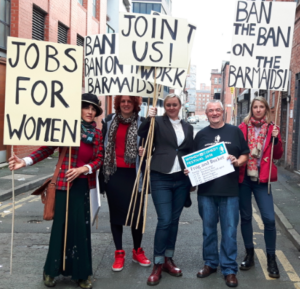
The newly devised performance, perambulation and protest were programmed in the Women in Comedy festival in Manchester.
Festival director Hazel O’Keefe won a Power Women Award from Manchester City Council for Women in Culture and Art.
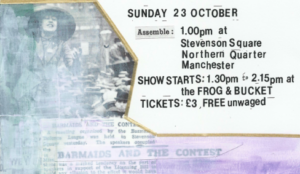
On the original day of protest in 1908 and the pseudo protest over a century later on exactly the same spot, women were told to go back to their kitchens at home – but they refused.

Willing members of the audience carried banners, including writer and translator Gul Turner (foreground), spoken word poet Kate Fox (left) and Manchester tour guide Anne Beswick (right).
While street protesting we were snarled at by two inebriated men. Sadly we were unable to make out their words.
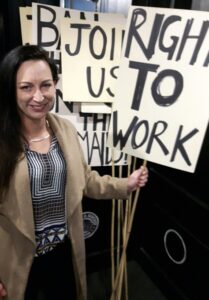
Winston Churchill and the cause
In 1908, a young local MP Winston Churchill was trying to get a ban through Parliament which would have stopped women from working in bars and taken bread from their tables. This ban was apparently to protect women from inebriated customers and to stop men from being lured into drink.
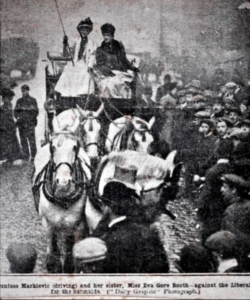
Social activists Esther Roper (a Northerner), Eva Gore-Booth and her sister Constance Markievicz rode to Stevenson Square in a carriage driven by four white horses to oppose the ban – and they won.

Thank you to Jenny White for sharing her social research on Esther Roper and women’s rights.
What did people who encountered the new protest in Manchester say?
“I like to sit back and relax on a Sunday. When I was asked on the spot to take a side in opposing the ban I probably had the loudest, most obnoxious voice. That felt good. Surprised me, actually.”
“So much energy.”
“We wouldn’t have come if it had been stand-up. Historical and political with the comedy – that’s what attracted us to come along.”
“Congratulations on a great show, well done on bringing the story alive :-)”
“Being given chance to carry a banner and walk to the venue.”
“Curiosity from lots of people, what we were doing standing there outside.”
“I’ve been a barmaid all my life. Sounds interesting, this. We don’t go to arty things.” (Two women who’d walked from Piccadilly train station with big suitcases They stood for five minutes listening to the protest and hearing about the carriage driven by four white horses and Suffragettes before asking:) “Where’s the Northern Quarter?”
“I stood with the others in Stevenson Square. I didn’t shout or anything or hold a banner.”
“It was inspiring – well done!”
“People rushing past with suitcases or eyeing us from outdoor cafes.”
“A few people ran after us and asked what the protest was about. I gave them a leaflet.”
“My friend thought it was really different.”
“I’ve never felt so valued.” (A barmaid working at the event)
“Are you doing it again?” “If you revive it please do let me know.” (x 6)
Thank you to all the local businesses for your support, including: the Frog and Bucket pub manager Jess and soundman Colin and company, director of the Women in Comedy Festival Hazel O’Keefe, Pie & Ale, Fred Aldous and Eastern Bloc.
Read about the political context here. (History Ireland on the Barmaids’ Defence League). And here (Sonja Tiernan of Liverpool University on the political writings of Eva Gore-Booth)